


Brave new material world
Do you feel overwhelmed by the number of gadgets and objects that surround you? What if you had just a few things that performed lots of different functions? Lining Yao and her fellow researchers in the United States are working on making that a reality.
A shoe that wraps itself around your foot. A wristband that morphs into a phone. A flower that changes shape and color when watered. A tea leaf that curls open when the tea is ready.
These are some of the concepts and materials that have been dreamed about and experimented with at the Massachusetts Institute of Technology (MIT) Media Lab’s Tangible Media Group, which is led by Professor Hiroshi Ishii. One product that has reached the prototype stage is called bioLogic fabric, a bacteria-based material that responds to heat and humidity. Breathable holes in garments made from the fabric can open up when the wearer is warm and sweaty.
The bioLogic team was led by Lining Yao, and other members include Wen Wang, Guanyun Wang, Helene Steiner, Chin-Yi Cheng, Jifei Ou, Oksana Anilionyte and Alana Solá.

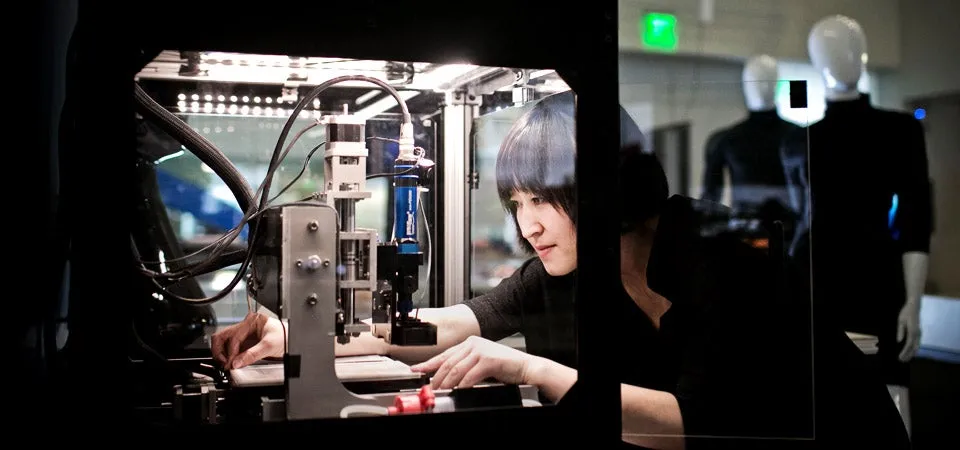
Lining Yao is a fourth-year PhD candidate at MIT, where together with her collaborators she has worked on these concepts and many more, as the lab’s researchers strive to envision materials of the future. She talked with Metalworking World about her work.
You grew up in Inner Mongolia, in China. How did that experience inspire your current work?
I came from a place where there was no computer or television, and my only media was nature-based. For example, I used to pick up pine cones from the forest. After a rain the pine cones were open, but when you take them home and leave them for a couple of days, the scales start to close up. I found that pine cone scales are very smart material. They can open and close many times – it’s a reversible transformation, and the stimulus is the moisture in the environment. It’s very similar to the way bioLogic material works.
What kinds of materials are you working with today?
In the bioLogic project, we looked into a type of bacteria called natto [used to make a popular fermented soybean dish in Japan]. It’s similar to pine cones, as it expands or shrinks based on the moisture percentage in the environment. We then use micron-sized bacteria to make different things, such as color-changing flowers or shape-changing lampshades. But the biggest application was the sweat-activated garments.
What other projects have you been involved in?
Before the bioLogic project, I was working with pneumatic-based materials together with researcher Ryuma Niiyama, Jifei Ou and my advisor Hiroshi Ishii. The major one was called Pneumatic User Interface, in which we borrowed techniques from soft robotics. We made soft, inflatable, shape-changing structures such as phones, lamps and iPad cases. It’s all very visual, so rather than explaining it in words, it would be easier if you were to watch some of the videos that are online (see films below).
Tell us about your work with shoes.
Together with my colleagues Jifei Ou and Daniel Tauber, we made a stiffness-changing shoe in collaboration with New Balance. Their sports designers had mentioned the different scenarios that were needed for shoes. For example, when you walk you need the shoe to be as soft as possible, but when you run you need support, and when you go climbing or hiking you need another part of the shoe to be stiff. So the question is, how can you dynamically tune the stiffness in different areas of the shoe?
Are you working to commercialize any of these projects?
We’re a research lab, so we’re more interested in a long-term vision than in commercializing things. We also see some technical barriers. For example, the garment fabric is not really washable, so then we try to think of one-time uses for specific scenarios, such as the Olympics, where the shirt would be used for a few days. We would love to see it used widely, but we don’t have the scope to fully explore the market space.
You’ve been working with what you call “responsive materials” for several years now. How do you see their future?
Responsive materials are definitely going to play a very interesting role in the future. By “responsive” I mean the materials start to have their own behavior and intelligence. They can sense different environmental stimuli, or how people are touching them or interacting with them, and can react with their shape, color, stiffness or their optical, mechanical or electrical properties. For example, the shoe could be able to sense if you’re walking or biking or hiking, and then could somehow compute your needs and output a different stiffness to support your activity. Or the garment could sense when you start to sweat and automatically respond by opening up. Then once you cool down it could close up to keep your body warm again.
How does your work contribute to sustainability?
The idea of responsive materials is to make one thing that can be used in multiple scenarios. I was trained as an industrial designer to choose different materials to design different products. Say you need two chairs. In the morning you want a not very comfortable chair for a short breakfast, to remind you that when you finish you have to stand up and go. But for your evening chair you want a couch with a smooth, soft surface. The essence of responsive material is the idea that one thing can be adapted for different scenarios. You can imagine that instead of buying five different chairs for different uses, now you can just buy one chair that will automatically adjust its stiffness and shape. Although studies are still in a preliminary stage, if the materials are robust enough and behave nicely, they should reduce the numbers of products you need to buy.
Do you have any advice for people in the materials industry?
I work in a multidisciplinary institution, and I think interaction between different disciplines is very important. Lots of scientists think the designer’s job is to take their invention and make it fancier. Designers consider themselves a bridge between the normal user and the scientist. But to me, inventions really come from a neutral respect of understanding others’ strength. The scientist and the designer have different imaginations based on their different ways of thinking. So I would encourage more interdisciplinary collaboration, and have the courage to do something you’re not familiar with.
Videos
Watch the films about Lining Yao's projects and materials.
A presentation for the Aspen Institute
A talk at the MIT Museum
