


Milling inside corners
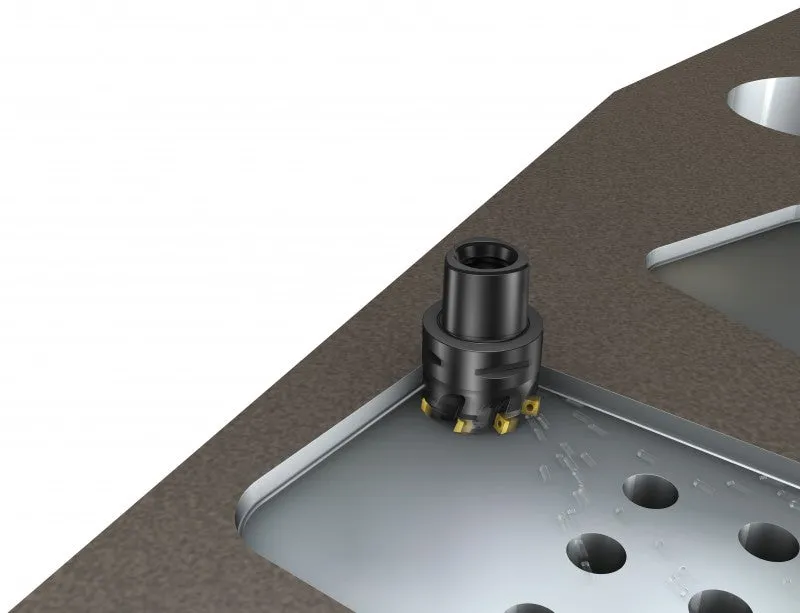
Milling inside corners requires careful considerations of the suitable arc of cutter engagement, as well as the appropriate feed rate.
Considerations
- When feeding the cutter into internal corners, the radial arc of engagement will increase and place extra demands on the cutting edge
- Often, the process becomes unstable, creating vibrations and an insecure process
- Wobbling cutting forces often create undercutting of the corner
- There is a risk for frittering the tool edges, or a total tool breakdown
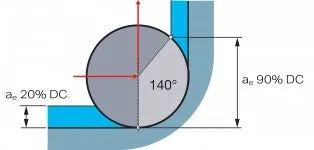
Traditional corner milling
Corner radius = 50% x DC
Solution – limit the arc of engagement
Use a programmed radius (circular milling) to reduce the arc of engagement and a radial cut to reduce the vibration tendencies, which will allow higher depths of cut and feed rates when milling inside corners.
- Mill a bigger corner radius than stated in the drawing. This can sometimes be favourable, as it allows the use of a bigger cutter diameter in roughing, which maintains high productivity
- Alternately use a smaller DC cutter to mill the desired corner radius
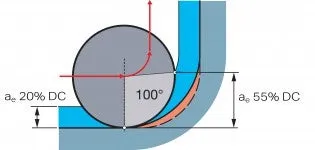
Mill a bigger component radius,
Corner radius = 75% x DC
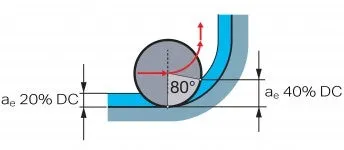
Use a smaller cutter,
Corner radius = 100% x DC
Roughing
A programmed radius of 50% DC is optimal.
Finishing
For finishing, it is not always possible to have such a large radius; however, the cutter diameter should be no larger than 1.5 x component radius, e.g. corner radius 10 mm (0.394 inch) = max 15 mm (0.591 inch).
Milling Cutter Path
This article explains how cutter path and chip formation influence tool life, heat, and vibration in milling and gives programming guidelines for entry, engagement, and cutter positioning. chevron_right
Widening Holes Milling
Widening a hole by milling explains selection between circular ramping and circular milling, including feed calculation, tool paths, and strategies to control chip thickness, vibration, and step marks. chevron_right
Thread Milling Guidelines
This article outlines practical recommendations for optimising thread milling operations and improving thread quality and tool reliability. chevron_right
Profile Milling Strategies
This article explains profile milling operations, tool choices, cutting data and toolpath strategies from roughing to super‑finishing in multi‑axis milling. chevron_right
